Sonntag, 21. Oktober 2012

Freikorps Werdenfels: Historical background (Pt. 2)


Freikorps Werdenfels – Assignment and action in Munich

Upon its belated arrival at Munich the Freikorps Werdenfels was assigned as reserve to the Bayerische Schützenkorps – Bavarian Rifle Corps under the overall command of Oberst Ritter von Epp. (The Rifle Corps as a whole became later sometimes referred to as the Freikorps Epp.) Task of the Bayerische Schützenkorps was to occupy the city district of Giesing. A very important and difficult task as the district was nearly completely inhabited by workers and thus considered a stronghold of the Council Republic and its supporters.

Oberst (Colonel) Franz Ritter von Epp

Hauptmann Wagner’s journal reports from various sentry, security and patrol duties performed by members of the Freikorps, they also took part in house searchings and assisted policemen in the arresting of suspicious people. On some occasions the Werdenfelser came under fire from snipers resp. hidden riflemen. Wagner gives the weapons collected by the Freikorps as follows: 1 light MG, 226 rifles, 1.400 rounds of ammunition, 1 crate of hand grenades, 1 hunting rifle and 1 army revolver. He does however not mention the number of opponents killed by the Freikorps Werdenfels. A different source claims that they killed ‘some’ (no concrete number is given) rooftop snipers and one man directing the fire of a concealed MG.

A report of a member of the Freikorps Schwaben also mentions the Werdenfelser (he prior described several exchanges of fire and how the Freikorps Schwaben occupied the Wittelsbacher bridge and took cover there):

‘[…] Zu uns gesellten sich auch Schützen vom Korps Werdenfels, die in ihrer Tracht erschienen und recht schnell mit ihren “Stutzen” zur Hand waren, wenn die Einwohner nicht rasch genug auf unsere Warnungsrufe: “Fenster zu, Kopf hinein!“ reagierten. Es war unbedingt notwendig, auch Neugierige zurückzuweisen, da man in der Hitze des Gefechts nicht unterscheiden konnte, ob einer bloss tatsächlich aus Vorwitz heraussah, oder ob er schiessen wollte.‘

   ‚[…] We were also joined by riflemen of the Korps Werdenfels, who appeared in their garb and were quick at hand with their ‘Stutzen’ (‘full stock rifle’), when the citizens didn’t respond quickly enough to our warnings: ‘Shut the windows, head inside!’. It was absolutely necessary to also keep nosey people back because in the heat of battle it wasn’t possible to distinguish between those who were just watching out of impertinence or wanted to shoot.’ 

Freikorps Werdenfels 'in action' (staged photo)

During the first days of fighting members of the Freikorps Werdenfels were on several occasions wrongly arrested by allied federal troops. Therefore the units operating in the neighboring areas received the following announcement on Mai 6th:

‘Die Angehörigen des der Gruppe Epp unterstellten Freikorps Werdenfels tragen meist Gebirgstracht. Sie haben eine gestempelte weissblaue order weisse Armbinde mit oder ohne schwarze Raute, und führen einen vom Freikorps Werdenfels, mit dem Stempel des bayerischen Schützenkorps versehenen Ausweis mit sich, der sie bis zur Verteilung der vorgeschriebenen Ausweis des A.O.K. Möhl auch zum Waffentragen berechtigt.‘

‚Members of the Freikorps Werdenfels assigned to the Group Epp usually wear mountain dweller garb. They have a stamped white-blue or white armband with or without a black diamond. They carry an identification card from the Freikorps Werdenfels with a stamp of the Bavarian rifle corps, this also entitles to the carrying of weapons until the distribution of the compulsory identification cards by A.O.K. Möhl.‘ 

On the morning of May 8th the Werdenfelser took part in a parade of the victorious ‘white’ troops through the city.

Freikorps Werdenfels on the 'victory parade'

On the Jugendspielplatz (the square was used as a parade ground) the Freikorps was inspected by Oberst Ritter von Epp und Generalmajor Möhl (the supreme commander of the ‘white’ forces). At this occasion Oberst Epp granted the Werdenfelser the following privilege: 
 
‘[…] in Annerkennung der tapferen Haltung […] am linken Arm den Löwen im schwarzen Rautenschild führen zu dürfen.‘

‚[…] in recognition of the brave attitude […] the permission is granted to carry the lion in the black diamond on the left arm.’ 
The von Epp lion

The Freikorps Werdenfels left Munich on May 10th. It did not suffer any casualties (besides those killed and injured in the train crash on their way to Munich).

Samstag, 20. Oktober 2012

Freikorps Werdenfels: Historical background (Pt. 1)


As mentioned in the last post, here’s the first part of the historical background to the Freikorps Werdenfels miniatures. (This part deals with the events leading to the fighting in Munich in May 1919 and the establishment of the Freikorps Werdenfels, while a second part will address their actions in Munich and a third the atrocities committed by both sides during the conflict and its aftermath and the role the Werdenfels played in it.)

I’ve tried to write this as objective and accurate as possible. Most of the information have been taken from the Historisches Lexikon Bayern, a historical online resource supported (among others) by the Bavarian State Ministry of Science, Research and Art, and the book Revolutionszeit 1918/19 im Bezirk Garmisch by Josef Ostler. To my knowledge both sources are only available in German language for the time being.

If you have got differing or additional information please let me know!


Overview of the events in 1918/19

This is a brief overview of the events in Munich and Bavaria in late 1918 and early 1919, which culminated in the fighting in Munich in May 1919. This is, of course, a simplification in a way as many of the causes and reasons for these events reach back even further.  

On November 7th, 1918 a big peace demonstration with 40.000 to 60.000 participants took place on the Theresienwiese (famous for being the location of the Oktoberfest) in Munich. Members of the USPD (Unabhängigen Sozialdemokratischen Partei Deutschlands – Independent Social Democratic Party of Germany) around the journalist Kurt Eisner took the lead of the demonstration and guided the people through the city. Meanwhile a much smaller group of USPD members succeeded in persuading the troops stationed in Munich to side with the revolutionaries. Following this success strategic points like the main station, the parliament and the telegraph office were occupied and worker’s and soldier’s councils established. 

Kurt Eisner (* 14. Mai 1867; † 21. Februar 1919)
In the night from November 7th to 8th Kurt Eisner proclaimed the Freistaat Bayern – Free State of Bavaria, the monarchy abolished and the holding of elections (in order to establish a parliamentary democracy) the main task of the new government for the time being taken over by the Provisorische Nationalrat – Provisional National Council, which elected Eisner the first Ministerpräsident – prime minister of Bavaria. All this happened without any bloodshed and took place two resp. one day prior to Philipp Scheidemann’s famous declaration of the German Republic in Berlin on November 9th, 1918.

Nearly all bigger towns and municipalities in Bavaria followed the example of Munich and established councils shortly after: amongst others Nuremberg, Fuerth, Augsburg and Wuerzburg on November 8th and Erlangen on November 9th. The more rural areas followed a lot later on,  some only on paper or not at all.
The election took place on January 12th, 1919 (in some parts of Bavaria on February 2nd). The outcome of the election intensified the situation considerably as the USPD achieved quite a bad result. Some of the most prominent points of contentions were the future role of the councils, the founding of militias in some parts of the country and the acknowledgement of Germany being the sole culprit of the Great War by Kurt Eisner in name of the Bavarian people.

Anton Graf von Arco auf Valley (* 5. Februar 1897; † 29. Juni 1945)
Kurt Eisner was assassinated on February 21st, 1919 by Anton Graf von Arco auf Valley, a Lieutenant of the Bavarian Leibregiment and nationalist (a former member of the Thule Society). This caused a lot of turmoil, which could not been stopped by the election of the new prime minister Johannes Hoffmann by the Bavarian Parliament on March 17th. The situation escalated on April 7th when the Central Council and the Revolutionary Worker’s Council together proclaimed the Baierische Räterepublik – Bavarian Republic of Councils. The government Hoffmann immediately relocated to the town of Bamberg in Franconia (northern Bavaria) with the parliament following shortly thereafter. Again, towns all over Bavaria followed the revolutionary example of Munich but this time only Augsburg, Rosenheim and their surroundings achieved more than a short lived change.     

Johannes Hoffmann (* 3. Juli 1867; † 15. Dezember 1930)
At first the government Hoffmann denied the intervention by federal troops and tried to gain control by the commitment of loyal voluntary Bavarian troops. But as their advances on Munich got repelled at Dachau and Freising on April 15th and 16th, they gave in to the enquiries from Berlin. Because of federalistic reasons, to save it’s face and to politically strengthen their position the government Hoffmann started to recruit as many Bavarian troops as possible to take part in the fight for Munich. The Freikorps Werdenfels was one of these  formations.


Freikorps Werdenfels – Establishment and trip to Munich

Responsible for the recruiting in the district Garmisch was Hauptmann Wanger, whose subaltern Leutnant Holler arrived in Garmisch on April 20th. The recruiting for the Freikorps Werdenfels started on April 29th, after several days of preliminaries. (One of the first recruiting posters gave the name wrongly with Freikorps Garmisch.) It is notable that not only ‘real’ locals got recruited into the Freikorps but also spa guests (the area was and still is a health resort) and people who had ‘stranded’ there through the turmoil caused by the end of the Great War and the events following thereafter. (Some of the recruiting posters and advertisements were explicit aimed at the later two groups and they made up a not so small portion of the Freikorps’ members.)

Recruiting finished on May 1st, with a total of about 260 men. They were organized into two companies (named Garmisch and Partenkirchen respectively) and came from very varied backgrounds: inactive officers, businessmen, doctors, friars, farmers, worker and even some pupils. Quite some of the participants hadn’t even reached the official age limit of 22 years. (They even took a former actor with them by the name of August Glonny (the composer of the Freikorps Werdenfels song), who was reported to not only be crippled but also very short sighted.) They left for Munich by train on May 1st and were supposed to arrive there on the next day. At a stopover at Weilheim at 8.30 p.m. they were joined by a group of officers including Major Josef Ritter von Reiss, who took over command from Hauptmann Wanger. One of these officers, Hauptmann Josef Seydel, wrote a journal about his time with the Werdenfelser. About this first encounter he noted:

‘[…]Stärke: 260 Mann mit Gewehren, 10 MG., 1 Personenkraftwagen, 1 Lastkraftwage und einige pferdebespannte Wirtschaftsfahrzeuge. Dieses Freikorps Werdenfels war – im Vertrauen gesagt – ein Sauhaufen ohne jegliche Disziplin und soldatischen Ernst. Der Marsch nach München war für diese Männer nichts weiter als „eine Gaudi“. […]‘

‚[…] Strength: 260 men with rifles, 10 MGs, 1 passenger car, 1 lorry and a couple of horse drawn supply carts. This Freikorps Werdenfels was – strictly in confidence – a bunch of slobs without any discipline or soldierly sternness. The march to Munich was nothing more than a blast to these men. […]’

After the men had quenched their thirst in Weilheim the trip was resumed. But at about 11 p.m. the Werdenfelser train was accidently hit by another train at Bernried. One man was killed in this crash and three men so badly injured that they had to be left behind for medical treatment. The rest of the men refused to continue the journey before dawn. The Freikorps set out again at about 5 a.m. on May 2nd.

Montag, 15. Oktober 2012

New Range: Freikorps Werdenfels

First of all a big sorry for those, who are waiting for a Russo-Japanese War update! 

The RJW will stay our main line (with hopefully many more miniatures to come) but it just beat another subject by a heartbeat when I had to decide, which range I wanted to get done over a year ago. A very close second had been the Freikorps Werdenfels. 

But as we say in German 'aufgeschoben ist nicht aufgehoben' (i.e. 'postponed is not abandoned'). They had to wait a little bit before they could make their debut but Paul has been working on them over the last months next to the Russians and Japanese and finally they are here.

The Freikorps Werdenfels

In short (I hope to post some more details over the coming days), these guys were part of the federal troops sent to Munich to fight against the Munich Soviet or Concil Republic in May 1919.

All miniatures sculpted by Paul Hicks with the notable exceptions of the Dachshund by eBob and the MG08, which is used under license from Musketeer Miniatures. All these miniatures have been painted by Andrew Taylor, as Simon is very busy (not least with some Russo-Japanese-War miniatures). This first release features the following five sets:

 FW-01 Command 
(containing a medic, an officer with a dachshund, a Stormtrooper/Veteran and a NCO )

FW-02 Riflemen advancing
(containing four different riflemen)
 
 FW-03 Riflemen firing
(containing four different riflemen)

 FW-04 HMG team
(containing a MG08 and a crew of three)

   FW-05 Specialists
(containing a Bugler, a Standard-bearer and a two-men MG08/15 team)

All miniatures are supplied unpainted and some require some modelling work!

All the above shown sets are priced € 7.50 each and are eligible as part of a five-set-deal for € 35.- (you can also get sets from different ranges as part of the very same deal, i.e. you can mix and match Japanese, Russian and Werdenfels sets in one five-set-deal, if you like).

We also have a special 'Werdenfels'-deal containing one each of the five sets FW-01 to FW-05 and a sheet of paper flags (shown below) from Flags of War for € 36.-.

The 'Freikorps Werdengels' range also marks the start of the cooperation with Flags of War, which will also see flags for the Russo-Japanese War (starting with the Japanese).

The 'Freikorps Werdenfels' flag sheet contains one generic Bavarian flag (that can be seen used on the painted example in the above picture of set FW-05) and a specific one for the Freikorps based on contemporary photos. 
The sheet is available as part of the 'Werdenfels'-deal are on its own, in which case it is prices € 2.50 per sheet.

(All prices exclude postage.)

Some potential FAQs:
Q: Why the odd make-up of the command and specialist sets?
A: Basically that's due to historical accuracy. While the command set is supposed to be accurate (except for the dog), the specialist set is more of an educated guess with no photographic evidence (for example the standards are shown on a couple of photos but only on those showing in-camp and on-parade-scenes).

Q: Will there be any additions?
A: Well, that'll come down to the reception of this first 'wave'. Plans include an assault set (armed with SMGs and a two-men flamethrower team) and a couple of sets of Bavarian civilians.

Q: Which sets of rules are these designed for?
A: These weren't designed with a specific set of rules in mind so it's up to you. There are a lot of suitable interwar rules available, my personal favourite being 'Triumph & Tragedy'. There's a free T&T-supplement available for the Freikorps-era at the Lead-Adventure-Forum.

Q: What else besides the actual historical background can the miniatures be used for?
A: Again, that's up to you. ;-) Pulp games spring to mind (why should always those dastardly Prussians have all the fun?), they could be allies or enemies of Hinterland's Hussar ladies and/or maybe part of an Bavarian Venus or Mars expedition in a VSF game. 
An interesting fact for the VBCW-fans, that Iain of Flags of War made me aware of, is that Rupprecht, Crown Prince of Bavaria was the heir to the Jacobite succession from 1919 until his death in 1955... so maybe after loosing his father's Bavarian throne, he might pursue the claimes he had inherited from his mother...


Samstag, 6. Oktober 2012

New castings are in

We received the castings of the three new sets from Griffin Moulds (I'm sorry about the bad photos):

 RJ-J08 Japanese Standard-bearers & Buglers
(incl. two standard tops with poles)

 RJ-R04 Russian Troopers charging

 RJ-R05 Russian Standard-bearers, Bugler and Drummer
(incl. two standard tops with poles)

PLEASE NOTE: The standard-beares require some modelling work, i.e. drilling out of the hands holding the standards.

These are now all available. ;-)

Dienstag, 2. Oktober 2012

More painted Russo-Japanese War miniatures

Again some amazing paint jobs by Simon Bradley of StoneColdLead Figure Painting.

First up is the rest of the Japanese:

 From left to right: NCO and Officer from RJ-J01 Japanese Officers & NCOs; Casualty and medic from RJ-J07 Japanese Casualties & Medical orderlies

Detail shot of the casualty and medic 'vignette' (just the two seperat miniatures put on a single base)


RJ-J05 Japanese Troopers firing I 


RJ-J06 Japanese Troopers firing II (with gassai-bukuro) 


 And also the Russian command miniatures to lead the troops from the front:

RJ-R01 Russian Officers & NCOs

Dienstag, 11. September 2012

New Release: Manchurian Bandits

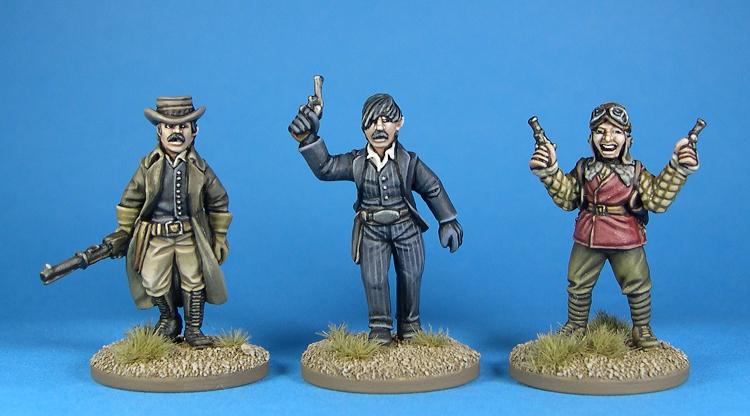
As the Russian Officers and NCOs set was our tenth relased set, it called for something to mark the occasion. So we are proud to announce the release of a set of Manchurian Bandits! (Manchuria remained a hot spot after the end of the RJW for the better part of the first half of the 20th century.) So while not strictly Russo-Japanese War related, these miniatures are at least geographically a good match.

 
 MISC-01 Manchurian Bandits

Please note, that the miniature on the left comes with both, the shown repeating rifle AND a double-barreled shotgun option. 
 
As always, Paul Hicks did the sculpting, Griffin Moulds the moulding and casting and Simon Bradley finished them of nicely with an amazing paint job, everybody has come to expect from him.

This set is now availble for € 6.50 and includes the three miniatures (the one on the left with two weapon options). All miniatures are supplied unpainted and unassembled!


Donnerstag, 6. September 2012

Banner tops greens

As promised here are the greens for the banner tops, which will be included with the standard-bearer sets. First up is the Japanese one. It is three-sided and shows the symbol of the royal family, a chrysanthemum blossom, on each side.


This will be included two times in the standard-bearer set as all the Japanese standards used this top. (I guess that's due to fact that the 'new' Imperial Japanese army had just been established in the decades before the Russo-Japanese War.)

The Russians on the other hand used a multitude of different standard tops. Therefore the Russian standard-bearer set will include two different variants (one of each), of what seems to be two of the most widely-used ones. 

The first top, similar to the Japanese one, is in form of the symbol of the Romanow dynasty the double-headed eagle.


The second one is in form of a drop with a cross inside. This cross, looking somehow similar to the Prussian/German Iron Cross, is the Cross of St. Georg a Russian decoration for valor first established during the Napoleonic Wars.